
The testosterone aisle runs on insecurity. There is a whole category of pills with names like “test surge” and “alpha matrix,” and they sell a fantasy: swallow this, feel like a younger man by Friday. It’s a multi-billion dollar promise.
It’s also, for the most part, not real.
The good news is that the things which do move testosterone are well studied, mostly free, and almost entirely ignored by the supplement industry, because you can’t put them in a bottle. There is exactly one supplement we think earns its place, and we’ll get to it. The rest is mostly noise. Here’s what actually works, and what’s a waste of your money.
First, the hard truth: most testosterone boosters don’t work
In 2023, researchers reviewed the “testosterone booster” supplements sold online and asked a simple question: do they actually raise testosterone? For most, the honest answer was no. Many had no human evidence at all, and a large share of the ingredients showed no real effect on testosterone in men.
Take the two most famous ones:
- Tribulus terrestris. A systematic review of clinical trials found that eight out of ten studies showed no meaningful change in men’s hormone levels. The couple that did were tiny and clinically irrelevant.
- D-aspartic acid. Early animal results looked promising. In humans, the results are inconsistent. Any small bump tends to fade within weeks.
That “proprietary blend” on the label isn’t a formula, it’s a curtain. It exists so the brand never has to tell you how little of each ingredient is inside. If a product promises to “boost your T by 40%,” that number came from marketing, not a lab.
So if the pills are mostly theatre, what actually works?
What actually raises testosterone (backed by research)
1. Sleep. This is the big one.
If you do nothing else, fix this. In a tightly controlled study at the University of Chicago, healthy young men who slept about five hours a night for just one week saw their daytime testosterone fall by 10 to 15 percent (Leproult & Van Cauter, JAMA, 2011). That is roughly the hormonal difference of aging ten to fifteen years, from one week of short nights.
Most of your testosterone is produced during sleep, and it tracks with how much deep sleep you get. No supplement on earth can out-muscle chronic sleep debt. Seven to nine hours is the lever almost no one pulls.
2. Lose excess body fat, and lift.
Body fat is not hormonally neutral. Fat tissue contains an enzyme called aromatase that converts testosterone into estrogen. The more excess fat you carry, the more of your own testosterone gets quietly turned into estradiol, which is one reason testosterone and waist size move in opposite directions.
The flip side is encouraging: studies consistently show that losing fat raises testosterone, with bigger drops in body weight linked to bigger rises in the hormone. Add resistance training, heavy compound lifts a few times a week, and you have the two most reliable, drug-free levers there are. Build muscle, drop the spare tyre.
3. Fix real deficiencies. Don’t megadose.
This is where supplements finally earn a place, with one important catch: they help if you are low, and do little if you are not.
- Vitamin D. It behaves like a hormone in the body, and correcting a deficiency can support healthy testosterone. Most people in offices and cloudy climates are low and don’t know it.
- Zinc. A genuine zinc deficiency lowers testosterone, and correcting it brings levels back up. Topping up beyond normal does nothing extra.
- Magnesium. Linked to better testosterone and muscle, especially alongside training. One study found 450 mg a day nudged levels up over four weeks, with a larger effect in men who exercised.
Notice the pattern. These aren’t “boosters.” They’re insurance against a deficiency that’s dragging you down. The smart move is a blood test first, then fix what’s actually low, rather than guessing.
The one supplement that actually earns its place: ashwagandha
If you do the four boring things above and still want something in a bottle, there is one ingredient with real human trial evidence behind it. It isn’t sold as a “test booster,” which is exactly why it’s any good.
Ashwagandha is an adaptogen, a plant that helps your body manage stress. Its main job is lowering cortisol, the stress hormone that works against testosterone. And when researchers measured testosterone directly, the numbers held up. In a controlled trial of men running an 8-week resistance-training programme, those taking a standardised ashwagandha extract (KSM-66, 600 mg a day) saw testosterone rise around 15 percent versus placebo, alongside better strength and recovery (Wankhede et al., 2015). Other trials in stressed and older men point the same way, with measurable rises in testosterone and drops in cortisol.
Two honest caveats, because we won’t pretend otherwise. The effect is real but modest, not a hormone overhaul, and it shows up most clearly in men who are stressed, under-recovered, or training hard, not necessarily in someone already sleeping well and lifting. Think of it as removing a brake (cortisol), not flooring the accelerator.
The form matters more than the brand. You want a standardised root extract, ideally KSM-66 or Sensoril, at around 600 mg a day, taken for at least 8 weeks. Skip cheap “ashwagandha powder” with no standardisation, and skip any “test blend” that hides ashwagandha inside a proprietary formula at a fairy-dusted dose.
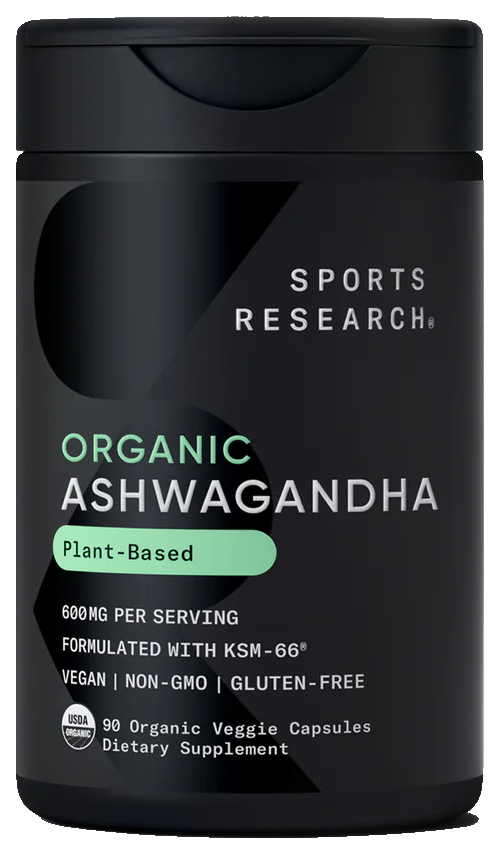
Our pick is a clean, single-ingredient KSM-66 at the studied dose: Sports Research Organic Ashwagandha (KSM-66, 600 mg) on iHerb, which ships across Asia (use code ARP7701 at checkout). One ingredient, the dose that was actually tested, nothing hidden.
A quick word on tongkat ali (Eurycoma longifolia): it’s the one other herb with a genuine signal, with several trials showing higher testosterone in older men and men with low levels. It’s promising and worth watching, but the products vary wildly in quality and the dosing is less settled. We’d start with ashwagandha and treat tongkat ali as the experiment.
The honest shortlist
We’d rather you fixed sleep and training first, and we don’t make our own pills. But if you want clean, well-dosed options that ship across Asia, no proprietary blends and every dose on the label, this is the entire list we’d actually reach for:
- Ashwagandha (KSM-66), the one with real evidence. This is the pick if you want a single supplement worth trying. A standardised KSM-66 extract at 600 mg a day, the dose used in the trials. Our pick is Sports Research Organic Ashwagandha on iHerb (code
ARP7701). Give it 8 weeks. - Magnesium (glycinate form), for sleep and recovery. Performance Lab Sleep is magnesium glycinate plus a small natural dose of melatonin. Skip the cheap “oxide” magnesium, your body barely absorbs it.
- Vitamin D3 + K2, only if you test low. Take it with a meal that has fat, and pair it with K2 so the calcium goes to your bones. A clean California Gold Nutrition D3+K2 on iHerb does the job (same code
ARP7701). - Zinc, only if you’re deficient. A simple zinc picolinate or bisglycinate. Available cheaply on iHerb with the same code.
That’s the entire list. Anything beyond it is mostly marketing.
What to skip
- Tribulus terrestris
- D-aspartic acid
- Any “proprietary test blend” that won’t print its doses
- Any product that promises you a guaranteed percentage on the label (real evidence lives in trials, not on packaging)
If it sounds like a shortcut, it’s a sales pitch.
A simple weekly protocol
You don’t need to overhaul your life. You need to do four boring things consistently:
- Sleep 7 to 9 hours. Protect it like a meeting you can’t miss.
- Lift heavy 3 times a week. Squats, deadlifts, presses, rows.
- Lean out. Get your waist down. Less aromatase, more testosterone.
- Fix the gaps. Get bloodwork, correct low vitamin D, zinc or magnesium, and go easy on alcohol, which suppresses testosterone.
Do that for a few months before you spend a cent on a “booster.” It’s free, it’s proven, and it works on far more than just one hormone.
FAQ
Do testosterone boosters actually work?
For the most part, no. Reviews of popular “booster” supplements find little to no reliable effect in healthy men. The deficiency nutrients (vitamin D, zinc, magnesium) only help when you’re low. The one ingredient with real direct evidence is ashwagandha, and even that is a modest effect, not a transformation.
Does ashwagandha really raise testosterone?
The evidence is genuine but modest. In controlled trials, men taking a standardised KSM-66 extract (around 600 mg a day for 8 weeks) showed measurable rises in testosterone versus placebo, roughly in the mid-teens by percentage, along with lower cortisol. It works best in men who are stressed or training hard. It’s a real edge, not a shortcut, and it won’t replace fixing your sleep and training.
How long does it take to raise testosterone naturally?
Sleep and alcohol changes can show up within a week or two. Fat loss and training build over months. Think in terms of a season, not a weekend.
Should I get my testosterone tested?
If you have symptoms like low energy, low libido, or poor recovery, yes. A blood test tells you whether you actually have a problem, and stops you guessing your way through supplements. Persistent symptoms are worth discussing with a doctor.
Is this medical advice?
No. This is general information on supporting healthy testosterone naturally. If you suspect a hormonal issue, see a qualified doctor.
Get one tested pick like this every week
We do this research so you don’t burn money finding out. The Edge is our free weekly email: the few things actually worth knowing, taking, and buying to be at your best, made for life in Asia. No hype, no sponsors. Join free.
Sources: Leproult & Van Cauter, JAMA, 2011; Wankhede et al., Journal of the International Society of Sports Nutrition, 2015; Chauhan et al., Health Science Reports, 2022; reviews of Eurycoma longifolia (tongkat ali) trials; “Do ‘testosterone boosters’ really increase serum total testosterone? A systematic review,” International Journal of Impotence Research, 2023; systematic review of Tribulus terrestris clinical trials, 2024.